 1f9d3a3523
There are now 2 separate classes for almost the same object type:
- EnumerableDeviceIdentifier, which is used in the enumeration code for
  all PCI host controller classes. This is allowed to be moved and
  copied, as it doesn't support ref-counting.
- DeviceIdentifier, which inherits from EnumerableDeviceIdentifier. This
  class uses ref-counting, and is not allowed to be copied. It has a
  spinlock member in its structure to allow safely executing complicated
  IO sequences on a PCI device and its space configuration.
  There's a static method that allows a quick conversion from
  EnumerableDeviceIdentifier to DeviceIdentifier while creating a
  NonnullRefPtr out of it.

The reason for doing this is for the sake of integrity and reliablity of
the system in 2 places:
- Ensure that "complicated" tasks that rely on manipulating PCI device
  registers are done in a safe manner. For example, determining a PCI
  BAR space size requires multiple read and writes to the same register,
  and if another CPU tries to do something else with our selected
  register, then the result will be a catastrophe.
- Allow the PCI API to have a united form around a shared object which
  actually holds much more data than the PCI::Address structure. This is
  fundamental if we want to do certain types of optimizations, and be
  able to support more features of the PCI bus in the foreseeable
  future.

This patch already has several implications:
- All PCI::Device(s) hold a reference to a DeviceIdentifier structure
  being given originally from the PCI::Access singleton. This means that
  all instances of DeviceIdentifier structures are located in one place,
  and all references are pointing to that location. This ensures that
  locking the operation spinlock will take effect in all the appropriate
  places.
- We no longer support adding PCI host controllers and then immediately
  allow for enumerating it with a lambda function. It was found that
  this method is extremely broken and too much complicated to work
  reliably with the new paradigm being introduced in this patch. This
  means that for Volume Management Devices (Intel VMD devices), we
  simply first enumerate the PCI bus for such devices in the storage
  code, and if we find a device, we attach it in the PCI::Access method
  which will scan for devices behind that bridge and will add new
  DeviceIdentifier(s) objects to its internal Vector. Afterwards, we
  just continue as usual with scanning for actual storage controllers,
  so we will find a corresponding NVMe controllers if there were any
  behind that VMD bridge.
SerenityOS
Graphical Unix-like operating system for x86-64 computers.



About
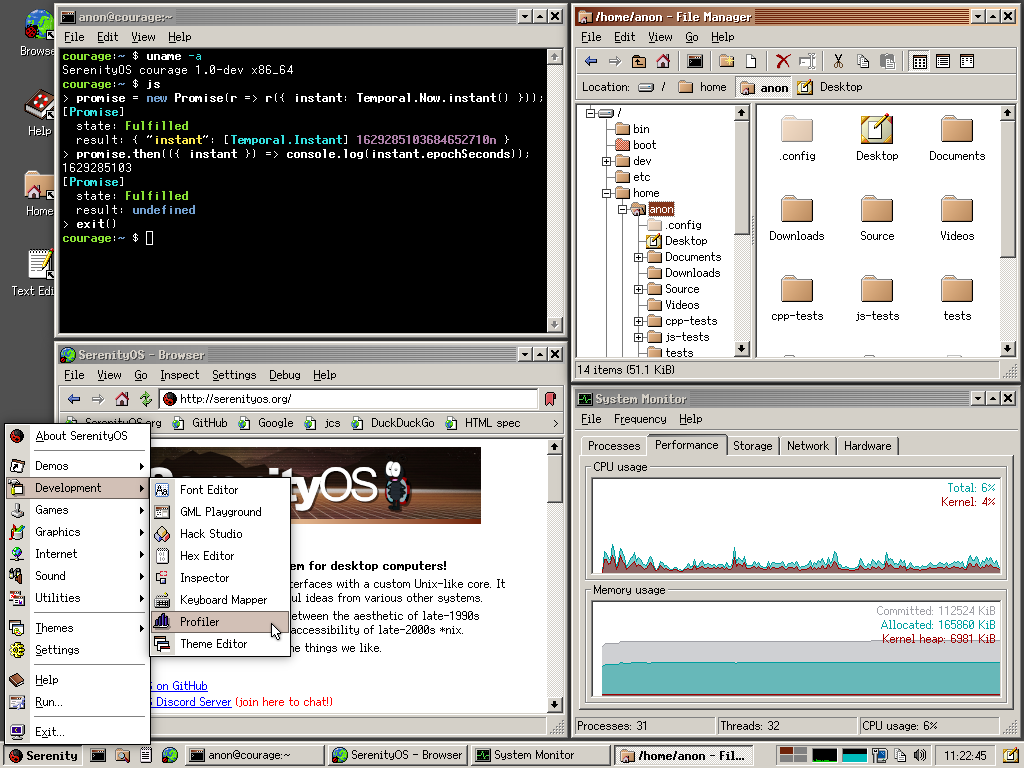
SerenityOS is a love letter to '90s user interfaces with a custom Unix-like core. It flatters with sincerity by stealing beautiful ideas from various other systems.
Roughly speaking, the goal is a marriage between the aesthetic of late-1990s productivity software and the power-user accessibility of late-2000s *nix. This is a system by us, for us, based on the things we like.
You can watch videos of the system being developed on YouTube:
FAQ: Frequently Asked Questions
Screenshot
Features
- Modern x86 64-bit kernel with pre-emptive multi-threading
- Browser with JavaScript, WebAssembly, and more (check the spec compliance for JS, CSS, and WASM)
- Security features (hardware protections, limited userland capabilities, W^X memory,
pledge&unveil, (K)ASLR, OOM-resistance, web-content isolation, state-of-the-art TLS algorithms, ...) - System services (WindowServer, LoginServer, AudioServer, WebServer, RequestServer, CrashServer, ...) and modern IPC
- Good POSIX compatibility (LibC, Shell, syscalls, signals, pseudoterminals, filesystem notifications, standard Unix utilities, ...)
- POSIX-like virtual file systems (/proc, /dev, /sys, /tmp, ...) and ext2 file system
- Network stack and applications with support for IPv4, TCP, UDP; DNS, HTTP, Gemini, IMAP, NTP
- Profiling, debugging and other development tools (Kernel-supported profiling, detailed program analysis with software emulation in UserspaceEmulator, CrashReporter, interactive GUI playground, HexEditor, HackStudio IDE for C++ and more)
- Libraries for everything from cryptography to OpenGL, audio, JavaScript, GUI, playing chess, ...
- Support for many common and uncommon file formats (PNG, JPEG, GIF, MP3, WAV, FLAC, ZIP, TAR, PDF, QOI, Gemini, ...)
- Unified style and design philosophy, flexible theming system, custom (bitmap and vector) fonts
- Games (Solitaire, Minesweeper, 2048, chess, Conway's Game of Life, ...) and demos (CatDog, Starfield, Eyes, mandelbrot set, WidgetGallery, ...)
- Every-day GUI programs and utilities (Spreadsheet with JavaScript, TextEditor, Terminal, PixelPaint, various multimedia viewers and players, Mail, Assistant, Calculator, ...)
... and all of the above are right in this repository, no extra dependencies, built from-scratch by us :^)
Additionally, there are over two hundred ports of popular open-source software, including games, compilers, Unix tools, multimedia apps and more.
How do I read the documentation?
Man pages are available online at man.serenityos.org. These pages are generated from the Markdown source files in Base/usr/share/man and updated automatically.
When running SerenityOS you can use man for the terminal interface, or help for the GUI.
Code-related documentation can be found in the documentation folder.
How do I build and run this?
See the SerenityOS build instructions. Serenity runs on Linux, macOS (aarch64 might be a challenge), Windows (with WSL2) and many other *Nixes with hardware or software virtualization.
Get in touch and participate!
Join our Discord server: SerenityOS Discord
Before opening an issue, please see the issue policy.
A general guide for contributing can be found in CONTRIBUTING.md.
Authors
- Andreas Kling - awesomekling
- Robin Burchell - rburchell
- Conrad Pankoff - deoxxa
- Sergey Bugaev - bugaevc
- Liav A - supercomputer7
- Linus Groh - linusg
- Ali Mohammad Pur - alimpfard
- Shannon Booth - shannonbooth
- Hüseyin ASLITÜRK - asliturk
- Matthew Olsson - mattco98
- Nico Weber - nico
- Brian Gianforcaro - bgianfo
- Ben Wiederhake - BenWiederhake
- Tom - tomuta
- Paul Scharnofske - asynts
- Itamar Shenhar - itamar8910
- Luke Wilde - Lubrsi
- Brendan Coles - bcoles
- Andrew Kaster - ADKaster
- thankyouverycool - thankyouverycool
- Idan Horowitz - IdanHo
- Gunnar Beutner - gunnarbeutner
- Tim Flynn - trflynn89
- Jean-Baptiste Boric - boricj
- Stephan Unverwerth - sunverwerth
- Max Wipfli - MaxWipfli
- Daniel Bertalan - BertalanD
- Jelle Raaijmakers - GMTA
- Sam Atkins - AtkinsSJ
- Tobias Christiansen - TobyAsE
- Lenny Maiorani - ldm5180
- sin-ack - sin-ack
- Jesse Buhagiar - Quaker762
- Peter Elliott - Petelliott
- Karol Kosek - krkk
- Mustafa Quraish - mustafaquraish
- David Tuin - davidot
- Leon Albrecht - Hendiadyoin1
- Tim Schumacher - timschumi
- Marcus Nilsson - metmo
- Gegga Thor - Xexxa
- kleines Filmröllchen - kleinesfilmroellchen
- Kenneth Myhra - kennethmyhra
- Maciej - sppmacd
- Sahan Fernando - ccapitalK
- Benjamin Maxwell - MacDue
- Dennis Esternon - djwisdom
- frhun - frhun
- networkException - networkException
- Brandon Jordan - electrikmilk
- Lucas Chollet - LucasChollet
- Timon Kruiper - FireFox317
- Gregory Bertilson - Zaggy1024

And many more! See here for a full contributor list. The people listed above have landed more than 100 commits in the project. :^)
License
SerenityOS is licensed under a 2-clause BSD license.